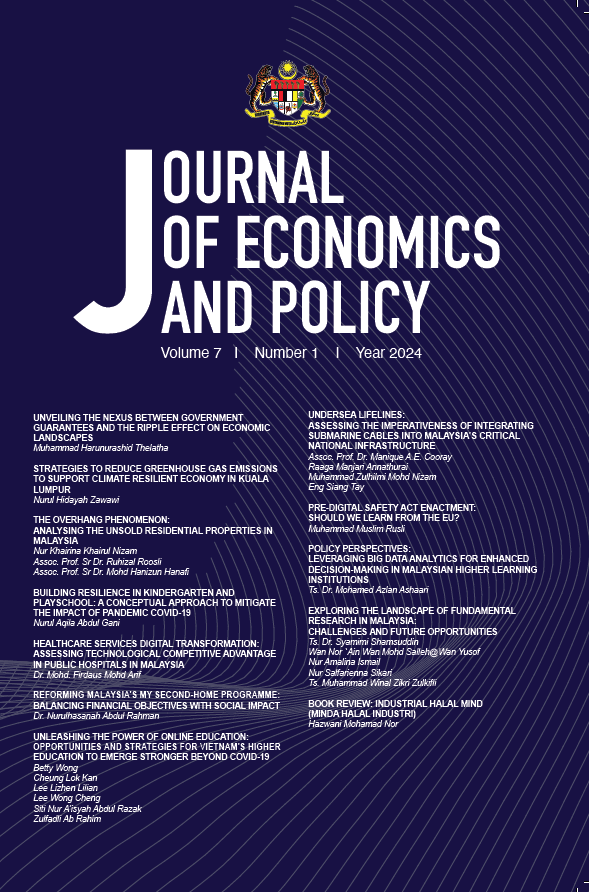
EXPLORING THE LANDSCAPE OF FUNDAMENTAL RESEARCH IN MALAYSIA: CHALLENGES AND FUTURE OPPORTUNITIES
Syamimi Shamsuddin
Wan Nor Ain Wan
Mohd Salleh@Wan Yusof
Nur Amalina Ismail
Nur Salfarienna Sikari
Winal Zikril Zulkifli
DOI:
Keywords:
Basic Research; Fundamental Research; Ministry of Higher Education; Global Innovation Index
Abstract
The development of modern technologies can often be traced back to fundamental, curiosity-driven research. Examples include the double helix structure of DNA, which laid the groundwork for genetics and genomics, and the global positioning system (GPS), which stems from Einstein's theory of relativity. The creation of COVID-19 mRNA vaccines also highlights the importance of basic research. Fundamental research, driven by the quest for knowledge rather than immediate practical applications, is crucial for generating new insights and methodologies that later translate into technological advancements. This study explores Malaysia's current policies and funding for fundamental research, emphasising its significance in building a robust innovation ecosystem. Basic research contributes significantly to human capital development, producing skilled graduates and researchers essential for economic growth. It also inspires future scientists and fulfils a fundamental human desire to understand the universe. Despite these benefits, interest in STEM fields is waning in Malaysia, underscoring the need for a strong education system that fosters curiosity and collaboration. Quality fundamental research enhances global academic rankings, drives innovation, and informs policy decisions, particularly in critical areas like vaccine development. Malaysia's Ministry of Higher Education (MoHE) supports fundamental research through various grant schemes. However, funding fluctuations have impacted the number of research projects and overall research output. Compared to countries like Singapore, Malaysia's investment in fundamental research is lower, affecting its global innovation standing. A dedicated policy for fundamental research, with clear objectives and sustainable funding, is imperative for Malaysia to maintain and enhance its scientific and economic competitiveness.
References
Baum, J. K., Dodd, M., Tietjen, K., & Kerr, J. (2017). Restoring Canada's competitiveness in fundamental research: The view from the bench. Global Young Academy, Berlin.
Buenker, R. J. (2011). A Modified Theory of Relativity Based on the Global Positioning System. Submitted for Publication.
Dissanayake, M. A. K. L. (2016). Basic and applied scientific research, innovation and economic development. Ceylon Journal of Science, 45(1), 1. https://doi.org/10.4038/cjs.v45i1.7368
Islam, Md. S., & Samsudin, S. (2020). Basic Research and Its Importance to Enhance Fundamental Knowledge in Resources and Environment Friendly Technological Advancement: The Holy Qur'anic Prescription. International Journal of Scientific and Research Publications (IJSRP), 10(10), 742-749. https://doi.org/10.29322/ijsrp.10.10.2020.p10693
Kementerian Kewangan Malaysia. (2019). Anggaran Perbelanjaan Persekutuan 2020. https://www.parlimen.gov.my/ipms/eps/2019-10-11/CMD.24.2019%20-%20CMD%2024.2019.pdf
Kementerian Pengajian Tinggi. (2023). Belanjawan 2024: Memacu kecemerlangan pendidikan tinggi negara. https://mohe.gov.my/hebahan/kenyataan-media/kenyataan-media-belanjawan-2024-memacu-kecemerlangan-pendidikan-tinggi-negara
Kim, S. Y. (2022). To boost South Korea's basic science, look to values, not just budgets. Nature, 606(7913), 229-229. https://doi.org/10.1038/d41586-022-01529-x
Klug, A. (2004). The Discovery of the DNA Double Helix. Journal of Molecular Biology, 335(1), 3-26. https://doi.org/10.1016/j.jmb.2003.11.015
Malaysia Science and Technology Information Centre (MASTIC). (2022). National Survey of Research and Development 2021.
Malaysian Investment Development Authority. (2023). Penyelidikan & pembangunan (R&D). https://www.mida.gov.my/ms/industri/perkhidmatan/penyelidikan-pembangunan-rd/
Malaysian Science and Technology Information Centre (MASTIC). (2020). National Survey of Innovation 2018. https://mastic.mosti.gov.my/sti-survey-content-spds/national-survey-innovation-2018
Malaysian Science and Technology Information Centre (MASTIC). (2024, July 12). National Survey of Research and Development. https://mastic.mosti.gov.my/sti/sti-survey/national-survey-research-and-development
Navaratnam, V. (2012). МОНE Research Grant Scheme. https://graham-kendall.com/download/Prof%20Dato%20Dr%20V%20Navaratnam.pdf
Newsome, R. (2023, August 30). Fostering a STEM ecosystem: Strategies for school leaders to cultivate a culture of innovation. Access. https://www.theaccessgroup.com/en-gb/blog/edu-fostering-a-stem-ecosystem/
Pusat Maklumat Sains dan Teknologi Malaysia. (2023). Indikator penyelidikan dan pembangunan (R&D). https://mastic.mosti.gov.my/ms/statistic/sti-trands/national-research-development-survey
Research, I. and E. S. (2016). Research Innovation Enterprise 2020 Plan Winning the Future through Science and Technology. https://www.mti.gov.sg/-/media/MTI/Resources/Publications/Research-Innovation-and-Enterprise-RIE-2020/RIE2020.pdf
Wang, C., Zhang, Y., & Dong, Y. (2021). Lipid Nanoparticle-mRNA Formulations for Therapeutic Applications. Accounts of Chemical Research, 54(23), 4283-4293. https://doi.org/10.1021/acs.accounts.1c00550
World Intellectual Property Organization (WIPO). (2018). Global Innovation Index 2018- Switzerland. https://www.wipo.int/edocs/pinkdocs/en/wipo_pub_gii_2018_ch.pdf
World Intellectual Property Organization (WIPO). (2023). Global Innovation Index 2023. https://www.wipo.int/edocs/pubdocs/en/wipo-pub-2000-2023/my.pdf